Executive Certified Digital Fraud & Identity Security Leader (EC-DFISL)
A strategic leadership programme for executives who need digital fraud and identity security to operate as a visible, reliable, and ...
Show more
Course details
Duration
100 guided learning hours
Level
Executive
Participants who successfully complete the course requirements and assessment will be awarded the Executive Certified Digital Fraud & Identity Security Leader (EC-DFISL) and will also receive a digital badge that can be shared on professional platforms, digital portfolios, and career profiles. This executive certificate confirms that the learner has achieved executive-level competence in leading digital fraud strategy, strengthening identity-risk governance, building e-forensics capability, coordinating incident oversight, and supporting enterprise digital-integrity assurance.
Full Life Time Access
Access on mobile and TV
Basic info
Level: Executive
Format: Professional certification course
Study Mode: Executive workshops, strategic discussion, and applied leadership activities
Typical Duration: 100 guided learning hours + executive strategy paper
Focus Area: Digital fraud strategy, identity-risk governance, e-forensics capability, incident coordination, and enterprise digital-integrity assurance
Assessment: Executive-level assessed certification that include strategic case analysis, governance exercises, leadership tasks, assurance reviews, an executive strategy paper, or a final assessment
Language: Depending on delivery arrangements
Course requirements
Participants are expected to have senior management, compliance, fraud-risk, digital security, investigations, governance, or executive leadership experience. A strong understanding of organizational accountability, digital risk, incident oversight, control environments, and enterprise decision-making will support effective engagement with the strategic and leadership dimensions of the course.
Intended audience
This certification is suitable for heads of digital fraud, identity-security leaders, compliance directors, fraud-risk executives, customer protection leaders, e-forensics managers, governance leaders, board advisors, and senior decision-makers responsible for digital-integrity oversight. It is designed for executive-level professionals who need to strengthen digital fraud governance, guide identity-risk strategy, and ensure visible accountability across the organization.
Popular courses


- Description
- Curriculum
- Reviews
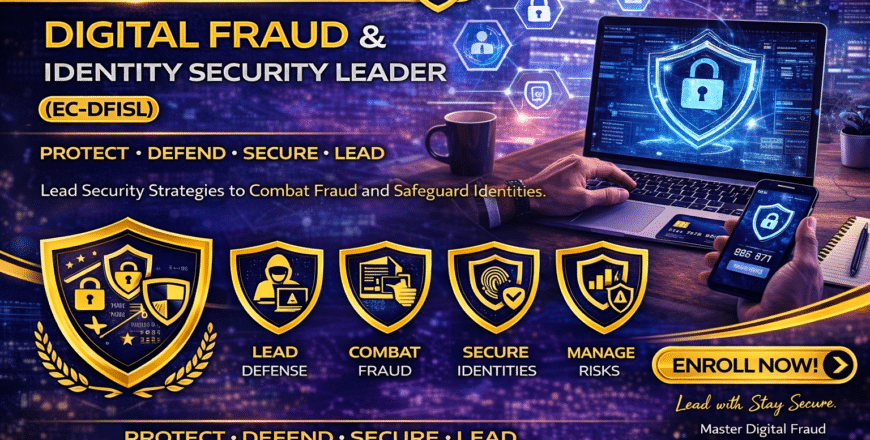
The Executive Certified Digital Fraud & Identity Security Leader (EC-DFISL) is designed for senior professionals, executives, and decision-makers who want to lead digital fraud prevention, identity-risk governance, and enterprise-level digital-integrity protection. This certification focuses on the strategic and leadership dimensions of digital fraud and identity security, enabling participants to guide digital fraud strategy, strengthen identity-risk governance, build e-forensics capability, coordinate incident response oversight, and support enterprise digital-integrity assurance.
Participants will explore key areas such as digital fraud strategy, identity-risk governance, e-forensics capability development, incident coordination, digital-integrity assurance, escalation governance, executive reporting, control environment leadership, and the alignment of fraud and identity-protection frameworks with organizational objectives and stakeholder expectations. The course also emphasizes the importance of translating digital fraud and identity risks into governance decisions, operational priorities, assurance structures, and executive accountability. It is ideal for leaders who must guide digital fraud and identity security not only as an operational issue, but as a core governance, resilience, and reputation priority.
Please, login to leave a review