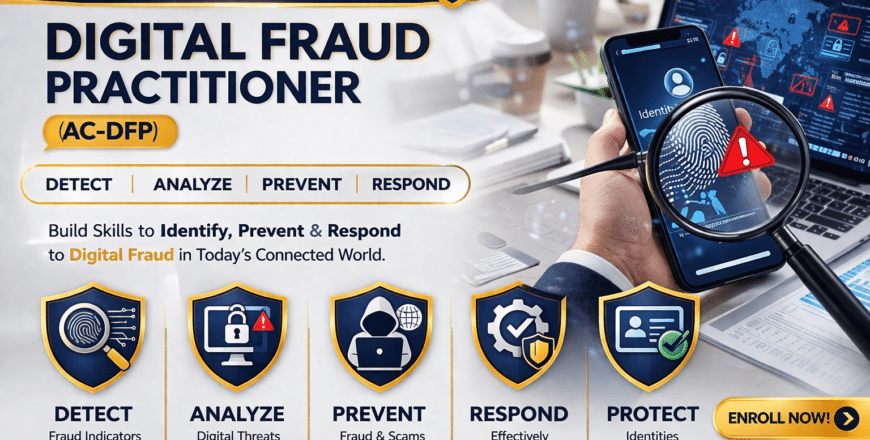
Associate Certified Digital Fraud Practitioner (AC-DFP)
A practical next step for learners who want to move from digital fraud awareness into real fraud-review and case-support activity. ...
Show more
Course details
Duration
60 guided learning hours
Level
Associate
Participants who successfully complete the course requirements and assessment will be awarded the Associate Certified Digital Fraud Practitioner (AC-DFP) and will also receive a digital badge that can be shared on professional platforms, digital portfolios, and career profiles. This practitioner certificate confirms that the learner has developed applied competence in identifying online fraud indicators, supporting digital case intake, reviewing account abuse, carrying out basic identity-risk analysis, and preserving evidence in professional digital-fraud environments.
Full Life Time Access
Access on mobile and TV
Basic info
Level: Associate
Format: Professional certification course
Study Mode: Workshops, guided practice, or blended learning
Typical Duration: 60 guided learning hours + 30 independent hours
Focus Area: Online fraud indicators, digital case intake, account-abuse review, basic identity-risk analysis, and evidence preservation support
Assessment: Practitioner-level assessed certification that include case-based exercises, review tasks, scenario analysis, documentation activities, or a final assessment
Language: Depending on delivery arrangements
Course requirements
Participants are expected to have completed the Foundation Certification in Digital Fraud & Identity Risk Essentials (FC-DIRE) or possess equivalent workplace exposure in customer support, compliance, fraud awareness, operations, digital services, or risk-related environments. A basic understanding of digital behavior, documentation, and escalation processes will support effective engagement with the practical elements of the course.
Intended audience
This certification is suitable for fraud-support staff, customer protection teams, junior compliance personnel, account-review staff, operations support teams, digital service personnel, and early-career professionals who want to strengthen their practical role in digital fraud review and identity-risk support. It is designed for entry practitioner level learners who want to contribute to day-to-day fraud detection and case-support activity in supervised professional settings.
Popular courses




- Description
- Curriculum
- Reviews
The Associate Certified Digital Fraud Practitioner (AC-DFP) is designed for learners and early-career professionals who want to develop practical capability in supporting digital fraud review and identity-risk handling in modern operational environments. This certification focuses on the applied side of digital fraud practice, helping participants build confidence in identifying online fraud indicators, supporting digital case intake, reviewing account-abuse patterns, carrying out basic identity-risk analysis, and preserving relevant evidence in a structured and responsible manner.
Participants will explore key areas such as online fraud indicators, digital case intake procedures, account-abuse review, identity-risk analysis, suspicious behavior patterns, documentation discipline, escalation awareness, and evidence preservation support. The course also highlights the importance of careful observation, secure handling, timely escalation, and consistent review practices so that participants can contribute effectively to fraud prevention and response activities in digital, customer-facing, financial, and operational environments. It is ideal for those who are ready to move from introductory awareness into supervised digital fraud practice.
Please, login to leave a review