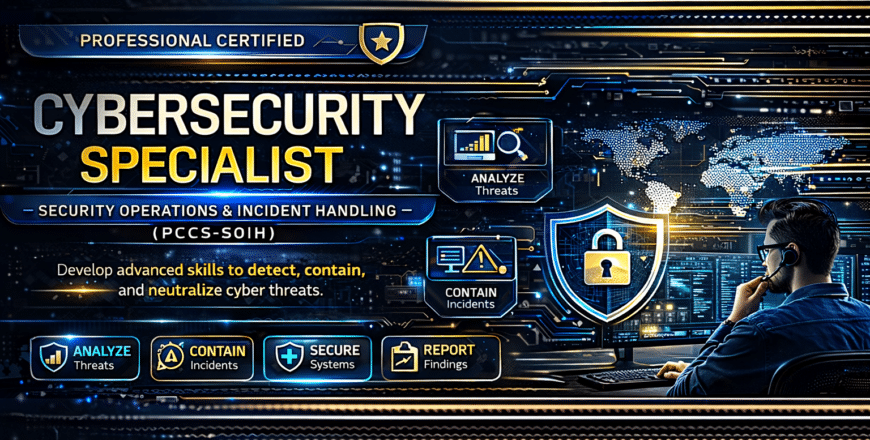
Professional Certified Cybersecurity Specialist – Security Operations & Incident Handling (PCCS-SOIH)
Ideal for professionals who want to function confidently as analysts and incident responders in active operational environments. The Professional Certified ...
Show more
Course details
Duration
80 guided learning hours
Level
Professional
Participants who successfully complete the course requirements and assessment will be awarded the Professional Certified Cybersecurity Specialist – Security Operations & Incident Handling (PCCS-SOIH) and will also receive a digital badge that can be shared on professional platforms, digital portfolios, and career profiles. This professional certificate confirms that the learner has achieved competence in independent security operations practice, incident analysis, investigation, reporting, and coordinated response, and demonstrates the ability to deliver operational cybersecurity tasks with professional confidence.
Full Life Time Access
Access on mobile and TV
Basic info
Level: Professional
Format: Professional certification course
Study Mode: Blended learning with practical labs and timed assessments
Typical Duration: 80 guided learning hours + 40 independent hours
Focus Area: Incident analysis, alert validation, vulnerability prioritization, hardening controls, endpoint and network event investigation, reporting, coordinated response, and evidence handling
Assessment: Professional-level assessed certification that include practical labs, timed assessments, case-based investigations, reporting tasks, and a final assessment
Language: Depending on delivery arrangements
Course requirements
Participants are expected to have completed the Associate Certified Cybersecurity Practitioner – Security Operations (ACCP-SO) or to possess 1–2 years of relevant IT or cybersecurity experience. Learners should be comfortable with basic security operations concepts, networking, operating systems, and core incident-handling workflows.
Intended audience
This certification is suitable for SOC analysts, security administrators, incident handlers, and junior DFIR staff. It is designed for mid-level practitioners who want to strengthen their ability to deliver operational security tasks independently and contribute more effectively to incident response and security monitoring functions.
Popular courses

- Description
- Curriculum
- Reviews
The Professional Certified Cybersecurity Specialist – Security Operations & Incident Handling (PCCS-SOIH) is designed for professionals who want to strengthen their independent capability in day-to-day security operations and incident response activity. This certification focuses on the professional practice of operational cybersecurity, helping participants develop the skills to investigate alerts, analyze incidents, prioritize vulnerabilities, apply hardening controls, and support coordinated response in active security environments.
Participants will explore key areas such as incident analysis, alert validation, vulnerability prioritization, hardening controls, endpoint event investigation, network event investigation, security reporting, coordinated response, case-based operations, and evidence handling. The course also emphasizes the importance of accuracy, structured investigation, documentation quality, and timely escalation in order to support effective security operations and incident handling. It is ideal for professionals who want to move beyond supervised operational work and function confidently as analysts and responders in real-world security settings.
Please, login to leave a review