Instructor
ASMC
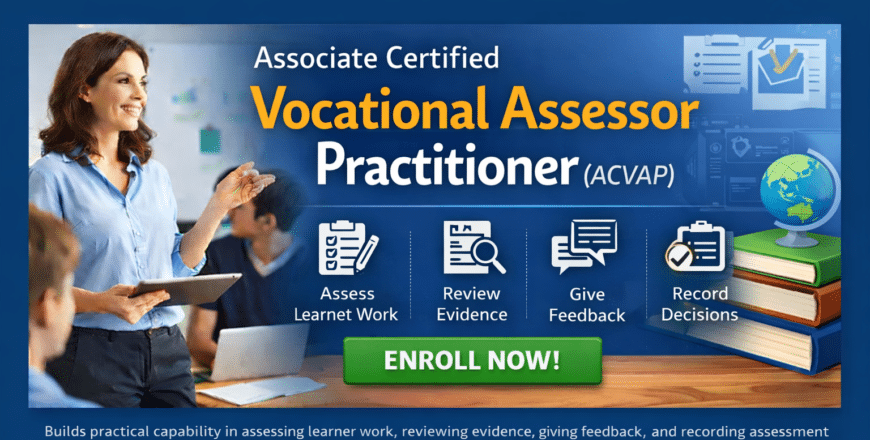
Associate Certified Vocational Assessor Practitioner (ACVAP)
Build the practical skills to assess vocational learning with confidence and consistency. The Associate Certified Vocational Assessor Practitioner (ACVAP) helps ...
Show more
Course details
Duration
60 guided learning hours
Level
Associate
Participants who successfully complete the course requirements and assessment will be awarded the Associate Certified Vocational Assessor Practitioner (ACVAP) and will also receive a digital badge that can be shared on professional platforms, digital portfolios, and career profiles. This certification confirms that the learner has achieved applied competence in assessing learner work, reviewing evidence, giving effective feedback, and recording assessment decisions in vocational settings.
Full Life Time Access
Access on mobile and TV
Basic info
Level: Associate
Format: Professional certification course
Study Mode: Online, face-to-face, or blended learning
Typical Duration: 60 guided learning hours / professional development program
Focus Area: Assessing learner work, reviewing evidence, feedback practice, assessment decisions, and recording assessment outcomes
Assessment: May include practical assessment tasks, evidence review activities, feedback exercises, case-based assignments, or a final assessment
Language: Depending on delivery arrangements
Course requirements
Participants are expected to have basic communication skills, general digital literacy, and an interest in assessment, teaching, training, or learner support. Prior exposure to vocational education, workplace instruction, or assessment-related activity is helpful but not mandatory. This certification is suitable for individuals who want to progress from foundational understanding to more practical and applied capability in vocational assessment practice.
Intended audience
This certification is suitable for junior assessors, vocational trainers, instructors, workplace supervisors, technical trainers, learner support staff, and early-career professionals involved in assessing learner performance or reviewing vocational evidence. It is also valuable for individuals working in vocational education, technical training, apprenticeship delivery, workplace learning, and other competency-based education and training environments.
Popular courses




- Description
- Curriculum
- Reviews
The Associate Certified Vocational Assessor Practitioner (ACVAP) is designed for learners and early-career professionals who want to develop practical capability in carrying out vocational assessment effectively and consistently. This certification focuses on the applied side of assessment practice, helping participants build confidence in assessing learner work, reviewing evidence, giving constructive feedback, and recording assessment decisions in line with vocational standards and assessment requirements.
Participants will explore key areas such as assessing learner performance, reviewing evidence for validity and sufficiency, applying assessment criteria, making assessment judgments, giving developmental feedback, maintaining assessment records, and supporting learners through the assessment process. The course also highlights the importance of fairness, consistency, accuracy, and professional responsibility in vocational assessment settings. It is ideal for those who want to move beyond introductory assessment awareness and build applied competence in day-to-day assessor practice.
Please, login to leave a review